The U.S. Postal Service’s Office of Inspector General estimated in a May 2025 report that New York City accounts for roughly $945 million a year in stolen-package losses — more than any other city it measured. That figure covers the whole city, not any one building, but it tells you the scale of what property managers are up against every peak delivery season.
Why Apartment Buildings Get Hit Harder
Package theft isn’t evenly distributed. Security.org’s 2025 annual package theft survey found that people living in apartments and condos report theft at roughly 3.5 times the rate of single-family homeowners. The reasons are structural, not random: a house has one front door and usually one household watching it, while a 40- or 100-unit building has one lobby, dozens of deliveries arriving from different carriers at different hours, and no single person responsible for what happens to a box after it’s dropped off. A doorman helps, but doormen go on break, work one shift, and can’t watch a growing pile of packages and the front door at the same time.
Three Ways Buildings Handle This Today
Most NYC buildings fall into one of three setups.
The most common, especially in older buildings, is an unsecured drop area: a corner of the lobby or a shelf near the front desk where carriers leave everything. It costs nothing to set up and nothing to maintain, and it’s also the setup most exposed to theft, since any resident, guest, or person who walks in off the street has access to every package sitting there.
The second is a wall of parcel lockers, the model used by services like Luxer One, Parcel Pending, and Amazon’s own locker network. A carrier scans a package into an assigned locker, and the resident gets a code to open that one compartment. This solves the “anyone can grab it” problem for anything small enough to fit in a locker, but locker walls take up real square footage, and oversized packages — the couch box, the case of water, the mattress — still end up sitting outside the system.
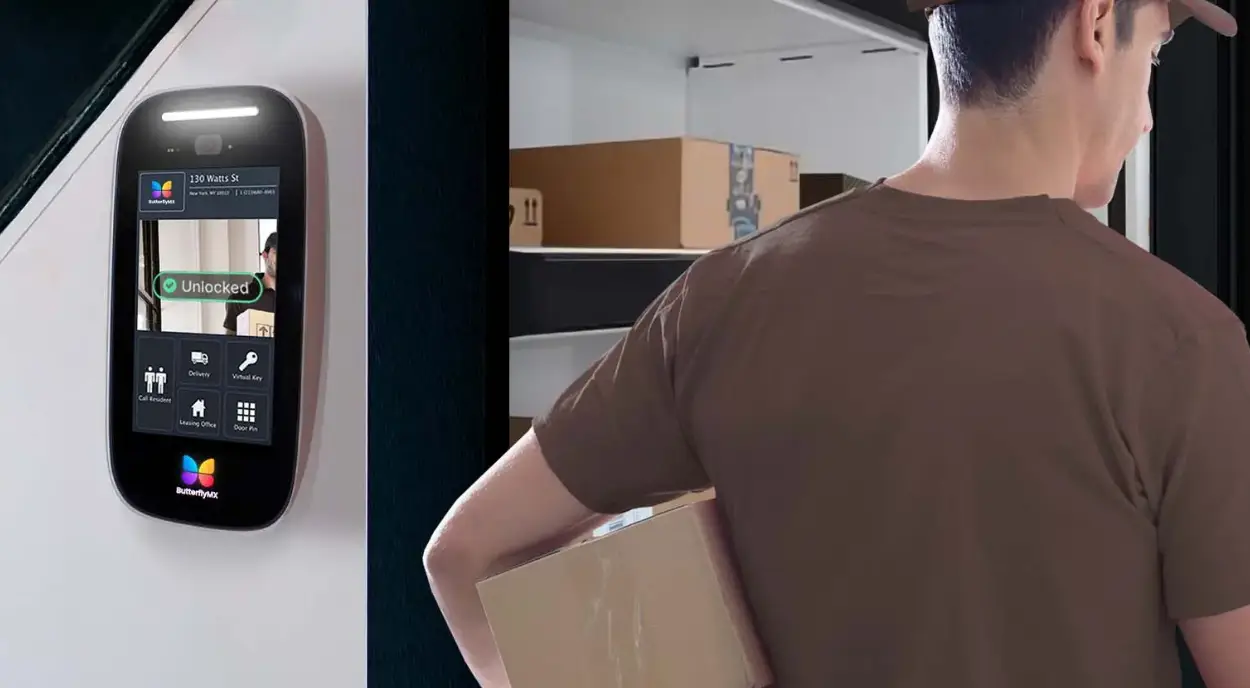
The third is a camera-monitored smart package room: a dedicated, locked room where every entry is logged. This is the category MetroCom installs, using the ButterflyMX Package Room system. A courier badges in through a panel that photographs and time-stamps the delivery; the resident gets a notification the moment their package is inside, and pickup requires a PIN code that’s also logged with a photo. Nothing about that process depends on a locker being the right size for the package, and the building ends up with a timestamped, photographed record of who came and went.
What a Smart Package Room Solves — and What It Doesn’t
A logged, camera-monitored room answers the question a property manager gets asked after almost every theft complaint: who was the last person to touch this package? It won’t stop a resident from claiming a package never arrived, but it gives the building a photo and a timestamp to check that claim against, instead of a shrug. It also removes the front-desk staff’s informal role as package custodian, which matters in buildings that don’t have staff on site around the clock.
What it doesn’t solve is a package left outside the building entirely — on a stoop, in a vestibule before the secure door — which is still the most common form of theft citywide. A package room only protects what actually makes it inside.
What It Costs
Based on MetroCom’s own published pricing for the ButterflyMX Package Room system, the software and access licensing runs from $30 to $42 per apartment unit annually, depending on which features and integrations a building selects. That figure doesn’t include the physical build-out of the room itself — the entry panel, cameras, door hardware, and any construction needed to convert existing space — which varies by building layout and is why we scope every package room on a site visit rather than a flat quote.
One Disclosure Worth Making Plainly
MetroCom sells and installs the ButterflyMX Package Room system rather than building our own package room software from scratch. We have a commercial relationship with ButterflyMX, and that’s worth stating outright rather than presenting this comparison as neutral. It’s also why the comparison above focuses on categories of solutions rather than a side-by-side of every competing brand’s pricing — we can speak with certainty about what we install and support, and less so about the current pricing and terms of systems we don’t sell.
What This Means for Your Building
If your building’s package area is a growing pile of boxes and a running list of resident complaints, the fix usually starts with a walkthrough of the space you actually have to work with. MetroCom’s smart package room installation covers the courier panel, resident notifications, and audit trail described above, and it’s frequently installed alongside our door access control systems so the same PIN or credential a resident uses to enter the building also unlocks their package.