A single elevator motor, a bank of fluorescent ballasts, or a subway line running under a building’s foundation can all do the same thing to a poorly planned camera cable run: fill the video feed with static-like interference, or drop the connection outright. When a building calls MetroCom to troubleshoot a problem like that, the camera itself is rarely at fault. The cable is.
Property managers and building owners across New York and New Jersey ask us to compare Cat6 and fiber optic cable before nearly every camera network upgrade. The honest answer is that neither one wins outright. Each is built for a different part of the job, and most buildings end up using both.
What Cat6 and Cat6a Actually Handle
Cat6 and Cat6a are the copper cabling standards most commonly used for individual camera drops.
Cat6 supports gigabit speeds over the full 100-meter (328-foot) run defined by Ethernet standards, and it can handle 10 Gbps at shorter distances, though performance typically falls off well before 100 meters at that higher speed. Cat6a was designed to close that gap: it holds a full 10 Gbps over the entire 100-meter run and includes heavier shielding, which helps it resist interference from the same sources — elevator motors, transformers, fluorescent ballasts — that cause trouble for lesser cable.
Both Cat6 and Cat6a carry Power over Ethernet (PoE), meaning a single cable delivers data and power to a camera at the same time. That single-cable simplicity is the main reason copper remains the standard for most individual camera runs: one cable, one trip up the ladder, no separate electrical work.
Where Fiber Pulls Ahead
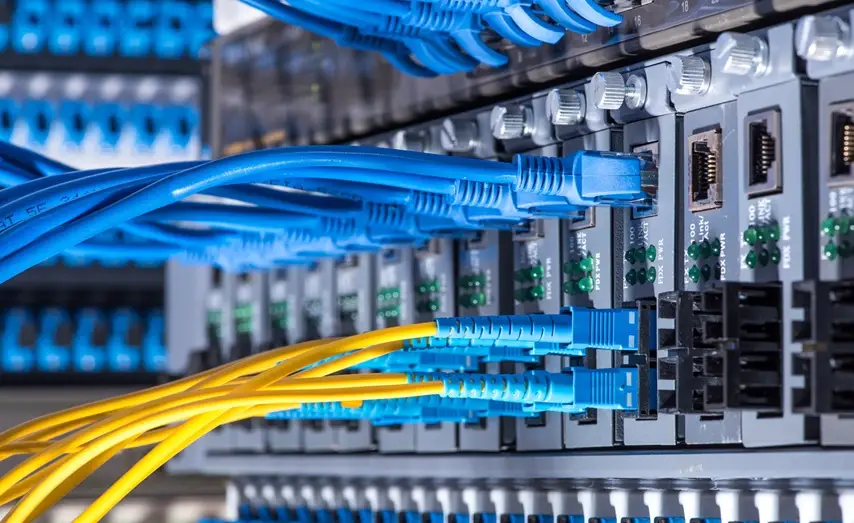
Fiber’s advantage is distance and immunity to interference. A fiber run can extend far past the 100-meter copper limit, which makes it the right tool for a backbone connecting a parking structure, a detached building, or a rooftop camera position back to the main equipment room. Fiber is also immune to electromagnetic interference, so it holds up in cable paths that have to pass close to electrical rooms or heavy machinery.
The tradeoff is that fiber does not carry power. Every camera fed by fiber needs its own local power source, or a media converter with a PoE injector at that end — which adds equipment and a second point of failure at each camera location. Fiber terminations also require more specialized tools and training than a standard copper punch-down, which is reflected in labor cost.
The Practical Answer for NYC and NJ Buildings
For most apartment buildings, retail stores, and commercial properties we work on, individual camera drops run on Cat6a for its PoE support and full 100-meter reach, while fiber carries the backbone between network closets, floors, or separate structures on the same property back to the main server or NVR room. A high-rise with cameras spread across multiple floors, or a campus with a detached garage or amenity building, almost always needs both: fiber to move data long distances without loss, and Cat6a to deliver power and data to the camera itself.
There isn’t a single cable that’s correct for every building. The right mix depends on the distances involved, what else is running through the same walls and ceilings, and how the building is laid out.
What This Means for Your Building
If you’re planning a new camera system or replacing aging wiring, the cable plan should come out of a site walkthrough, not a generic spec sheet. MetroCom’s computer network and structured cabling services cover both the Cat6a and fiber side of a build-out, and our security camera installation services in NYC and NJ are designed around whatever cable plan the building actually needs.
One disclosure worth making plainly: MetroCom sells and installs both copper and fiber infrastructure, along with the camera and recording equipment discussed here. We have a commercial interest either way. That’s exactly why our recommendations are based on a building’s physical layout and existing wiring, not on a single product we’d rather sell.